

Preface
In peacetime, conducting high-intensity military activities in a coastal state’s surrounding waters, such as thousands of close-in reconnaissance operations and hundreds of targeted military exercises, is contrary to the spirit of the UN Charter, the Five Principles of Peaceful Coexistence, and the principles and rules of international law, including “the peaceful uses of the seas” stipulated in United Nations Convention on the Law of the Sea (UNCLOS).
Since 2009, US military activities against China in the South China Sea have escalated both in frequency and intensity. In 2025, amidst the Russia-Ukraine conflict and the US-Israel-Iran conflict, US naval and air forces were continually constrained by situations in the Caribbean, the Middle East, and other regions, leaving them overstretched. Nevertheless, they still maintained a high-intensity military presence in the South China Sea and its periphery.
Under the second Trump administration, the South China Sea has clearly not been a primary focus for the US. However, the US military on the frontlines of the Western Pacific has remained in “autopilot”, continuing to intensify its military presence and activities in the South China Sea. In 2025, the activities of strategic platforms such as carrier strike groups, amphibious ready groups, and bombers showed limited growth, while the frequency of declaratory operations like Freedom of Navigation Operations (FONOPs) declined. Nevertheless, close-in reconnaissance, drills and exercises, and joint operations with allies and partners saw significant increases.
The US military presence and operations remain major factors affecting the situation in the South China Sea. Since 2019, the South China Sea Strategic Situation Probing Initiative (SCSPI) has annually released an Incomplete Report on US Military Activities in the South China Sea of previous year based on open-source data. The report is intended to promote the transparency regarding the South China Sea situation and provide the perspective as a reference for policymakers, research institutions, the media and the public of relevant parties.
Director of SCSPI Hu Bo

Key Findings
I. The Sluggish Growth of Strategic Platform Activities
1. CSGs
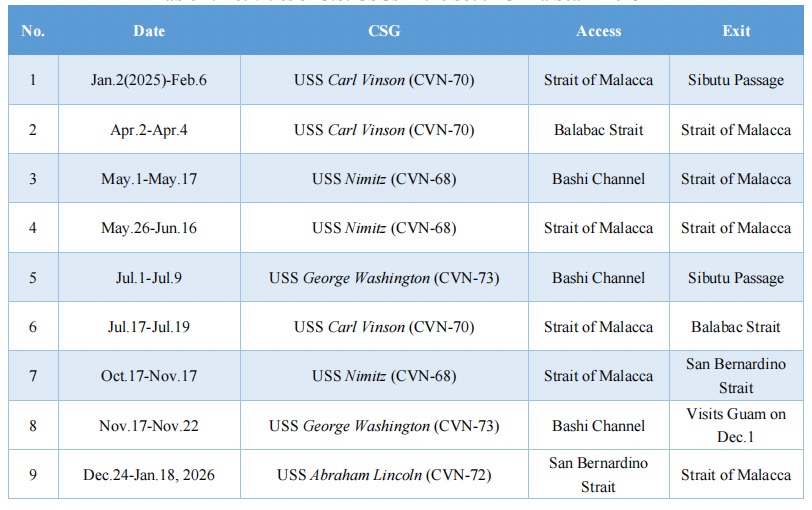
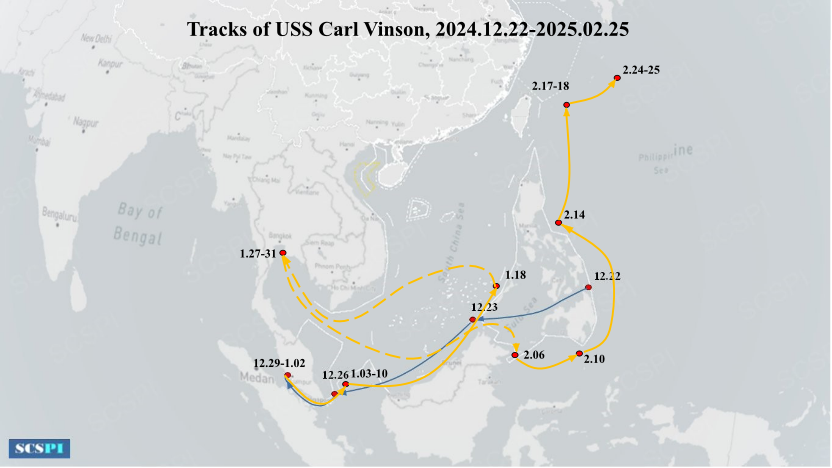
In 2025, the US military dispatched 4 CSGs, USS Carl Vinson (CVN-70), USS Nimitz (CVN-68), USS George Washington (CVN-73) and USS Abraham Lincoln (CVN-72), for a total of 9 activities accessing the South China Sea.
2. Amphibious Ready Groups (ARGs)
In 2025, the US deployed 2 ARGs in the Western Pacific, namely USS America (LHA-6) and USS Tripoli (LHA-7), but only the latter made a single entry into the South China Sea. Although this number has increased slightly compared to that of 2024, the shortfalls in amphibious readiness are still conspicuous.
3. Nuclear-powered Submarines
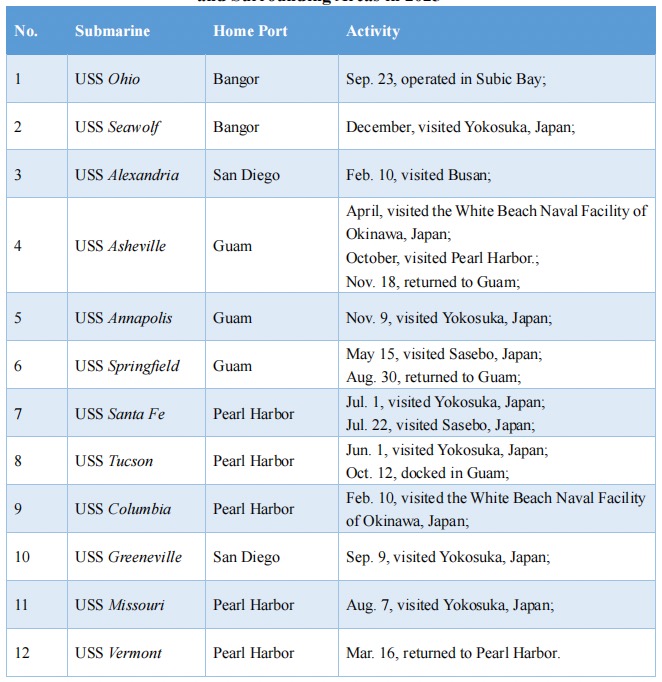
In 2025, the US has deployed at least 1 nuclear-powered guided missle submarine and 11 nuclear-powered attack submarines. Based on the operational footprints of auxiliary vessels, US submarine activities spanned the entire Western Pacific, encompassing the South China Sea, the East China Sea, and the Java Sea.
4. Bombers
According to open source information, the US Air Force (USAF) has dispatched a total of 13 sorties across 7 missions of B-52H and B-1B bombers to the Western Pacific region for patrol operations, seeing a decrease in both quantity and frequency compared to previous years.
II. Uneven Growth in Aerial and Maritime Close-in Reconnaissance
1. Aerial Close-in Reconnaissance
Based on incomplete statistics, in 2025, US reconnaissance aircraft conducted a cumulative total of approximately 1200 sorties in the South China Sea, representing a moderate increase compared to 2024, attributed primarily to drones and air bases in the Philippines. These reconnaissance missions were launched from multiple outposts, including Kadena Air Base in Okinawa, Osan Air Base in the ROK, Andersen Air Force Base in Guam, and Clark Air Base in the Philippines.
2. Maritime Close-in Reconnaissance
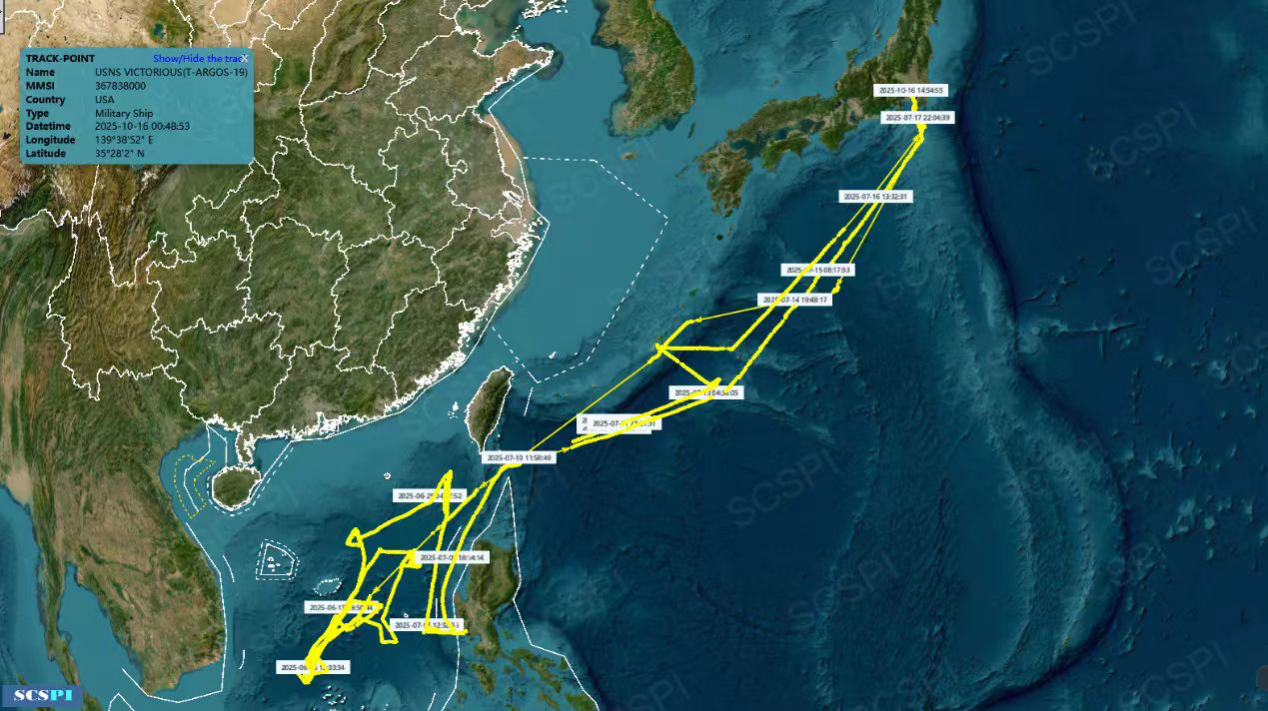
In 2025, the US military deployed 4 ocean surveillance ships to the South China Sea: USNS Victorious (T-AGOS-19), USNS Able (T-AGOS-20), USNS Effective (T-AGOS-21), and USNS Impeccable (T-AGOS-23), alongside 3 oceanographic survey ships: USNS Bowditch (T-AGS-62), USNS Henson (T-AGS-63), and USNS Mary Sears (T-AGS-65). Their cumulative operational time in the South China Sea amounted to 197 ship-days. Among them, the ocean surveillance ship USNS Victorious was the most active of all the reconnaissance vessels, operating for 55 days.
III. Low-frequency Declaratory Operations
1.Island-Intrusive Freedom of Navigation Operations (FONOPs)
In 2025, the US military conducted only 2 public island-intruding FONOPs, the same as in 2024, showing a general decline compared to previous years. However, other types of FONOPs have not diminished. In August 2025, the US Department of Defense released the FY24 Freedom of Navigation Report, which detailed challenges to 19 “excessive maritime claims” by 11 countries or regions.
2. Taiwan Strait Transits
Throughout 2025, US warships transited the Taiwan Strait three times, each accompanied by high-profile public statements. The year represents a continuation of the downward trend in transits since 2020, with five in 2024, six in 2023, nine in 2022, and 12 in 2021.
IV.Continuously Boosted Joint Operations with Allies
1. Strengthening Infrastructure and Forward Deployments
In 2025, the US continued to regard the Philippines as a critical node in its South China Sea military network. First, it accelerated upgrades and expansions at multiple Philippine bases under the framework of Enhanced Defense Cooperation Agreement (EDCA). Second, within the framework of Mutual Defense Treaty (MDT), the US and the Philippines continuously strengthened the military presence via frequent joint drills and institutional dialogues.
2. Advancing Intelligence Technology and Situational Awareness Cooperation
In 2025, the US and its allies further institutionalized and expanded intelligence-sharing mechanisms in the South China Sea, with a particular focus on multilateral frameworks among the US, Japan, Australia, and the Philippines.
V. Upgraded Multi-Domain Joint Exercises
1. Expanded Alliance and Strengthened Multilateral Efforts
Faced with increasingly limited resources, the US military has significantly increased joint exercises in the region with both regional and extra-regional allies.
2. Deepened Integration of Multi-Domain Data and Factors
Unlike past exercises that weighed more on traditional joint operations, US military drills in 2025 emphasized the integration of factors such as unmanned systems, long-range firepower, cyberspace, and artificial intelligence, reflecting a shift toward high-end warfare.
3.Scenario-Based Exercises Centered on South China Sea Hotspots
Unlike the previous broad “Pan-Pacific” frameworks, in 2025, exercises targeted specific South China Sea hotspots, focusing on sensitive areas like Second Thomas Shoal, Scarborough Shoal, and strategic straits, with scenario-based crisis response replacing symbolic displays.
Please download PDF for full report.
SCSPI

With a view to maintaining and promoting the peace, stability and prosperity of the South China Sea, we launched the South China Sea Strategic Situation Probing Initiative (SCSPI). The Initiative aims to integrate intellectual resources and open source information worldwide and keep track of important actions and major policy changes of key stakeholders and other parties involved. It will provide professional data services and analysis reports to parties concerned, helping them keep competition under control, and seek partnerships.