
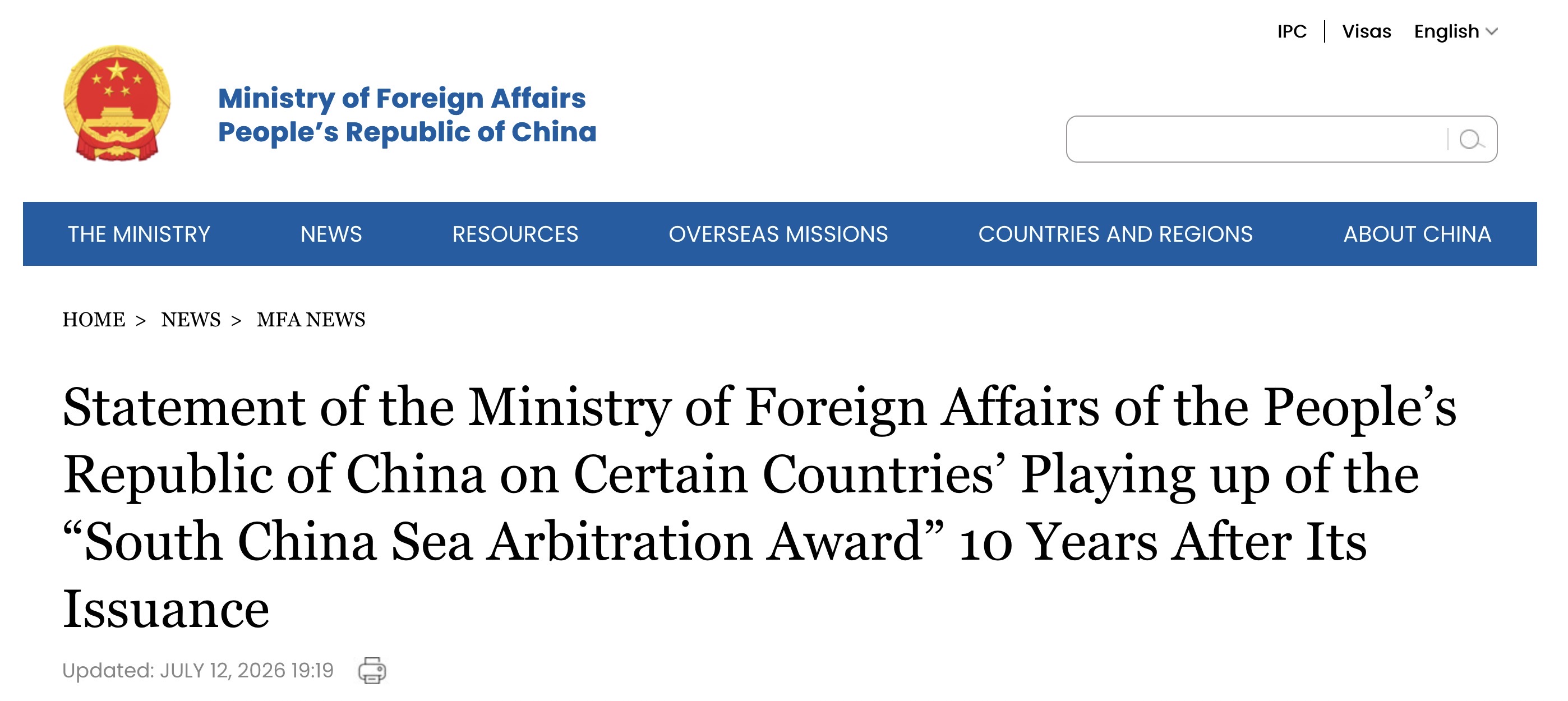
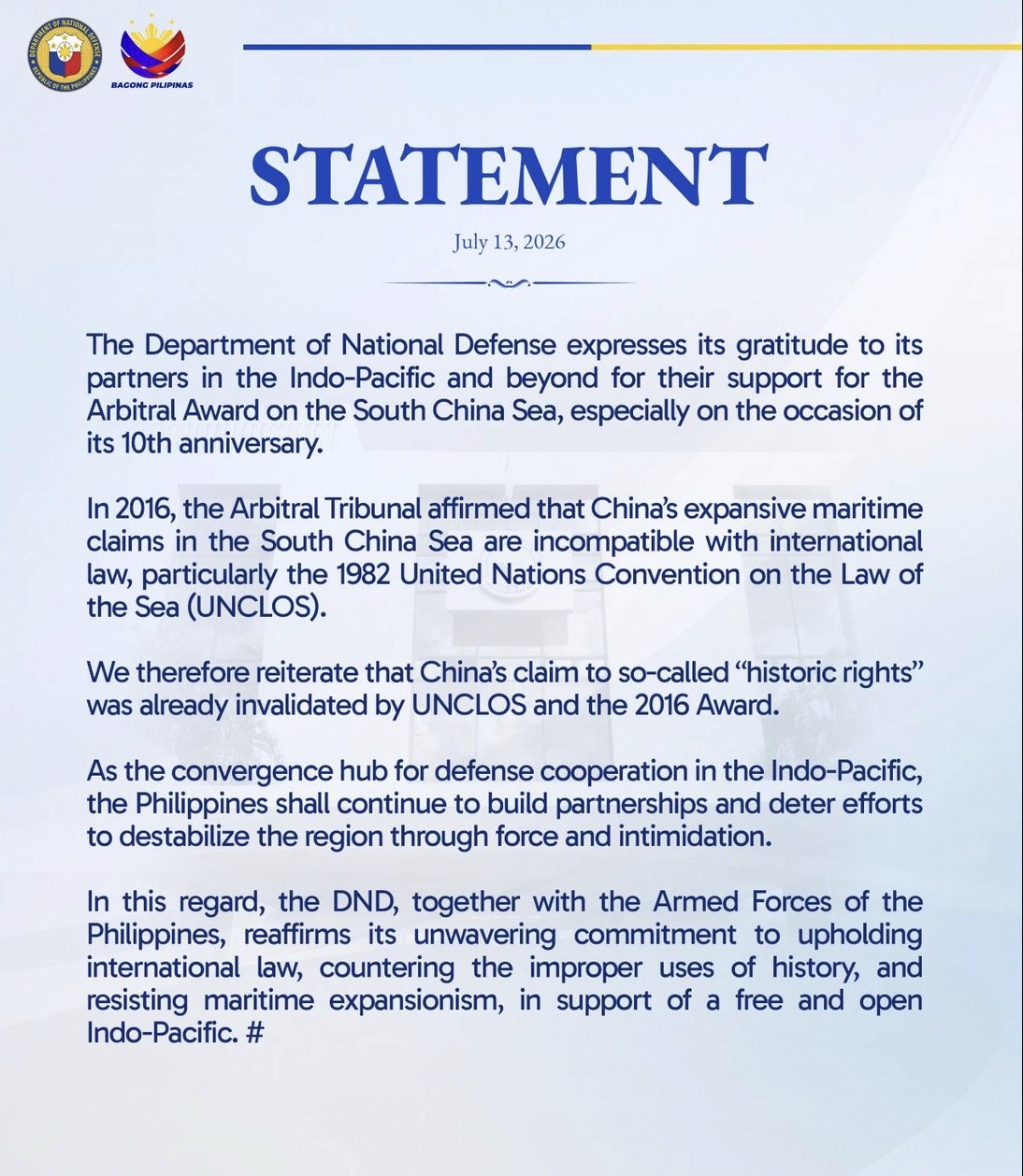
Ten years after the South China Sea arbitration award was issued, one question deserves renewed attention: if an international ruling neither resolved a dispute nor reduced tensions, should it continue to define the region’s diplomacy?
For ASEAN countries, this is not merely a legal question, but a strategic one. The region’s long-term interest lies in preserving peace, maintaining its diplomatic autonomy and ensuring that disputes are managed rather than allowed to escalate. Viewed through this lens, the arbitration has left a problematic legal legacy and an even more troubling political one.
The 2016 award did not settle the dispute between China and the Philippines. Instead, it reshaped the way the dispute is conducted. It narrowed diplomatic flexibility, hardened political positions and increasingly drew the South China Sea into wider geopolitical competition. A decade later, these consequences deserve as much attention as the legal reasoning of the award itself.
International law is most effective when it helps states reach practical accommodation. Its authority ultimately depends not only on legal reasoning but also on acceptance by states and consistent implementation over time. When legal outcomes become politically irreconcilable, their ability to stabilise the situation is inevitably compromised.
The South China Sea arbitration award illustrates this dilemma.
Before 2016, China and the Philippines disagreed fundamentally over maritime claims, yet successive governments retained room for negotiation. Disputes were managed alongside broader cooperation, allowing both countries to compartmentalise differences while expanding economic and political ties.
The arbitration altered that dynamic. By presenting contested issues in definitive legal terms, it reduced the political space available for compromise. Positions that might once have been negotiated became increasingly difficult to adjust without appearing to concede principle. Rather than removing politics from the dispute, the award made political compromise more difficult.
The consequences have extended beyond diplomatic negotiations. Maritime encounters are now frequently accompanied by intense media attention, rapid circulation of video footage and competing public narratives. Incidents at sea have become political events almost as soon as they occur, increasing pressure on governments to demonstrate resolve rather than restraint. This environment leaves less room for pragmatic crisis management and increases the risk of miscalculation.
The longer such dynamics persist, the greater the danger that strategic competition will evolve into entrenched public hostility. Once disputes become embedded in national identity and public expectations, rebuilding trust becomes considerably more difficult than restoring diplomatic dialogue.
The arbitration has also complicated ASEAN’s preferred approach to regional order.
For decades, most ASEAN countries have managed sensitive security issues through consultation, gradual confidence-building and consensus. The 2002 Declaration on the Conduct of Parties in the South China Sea and the ongoing negotiations over a Code of Conduct reflect this tradition. Progress has often been slow, but the underlying principle has remained consistent: regional disputes are most durable when regional states retain ownership of the process.
The arbitration has made that approach harder to sustain. Where the award is treated as the starting point for negotiations rather than one legal position among several, diplomatic flexibility narrows. Legal arguments risk replacing political bargaining, while technical questions become symbols of broader strategic competition.
At the same time, the dispute has become increasingly internationalised. External powers have cited the award to justify a more active role in the South China Sea, linking regional maritime disputes to wider strategic rivalry. As major-power competition intensifies, ASEAN’s ability to preserve its central role becomes more difficult.
For Southeast Asia, this is perhaps the most significant consequence. The region has long sought to avoid becoming an arena in which larger powers compete for influence. Preserving ASEAN centrality requires maintaining sufficient diplomatic space for regional solutions rather than allowing external geopolitical competition to dominate regional affairs.
The arbitration has also generated continuing debate over the operation of the United Nations Convention on the Law of the Sea (UNCLOS).
International law derives its legitimacy from more than judicial decisions alone. It also depends on procedural fairness, judicial restraint and broad acceptance by states. Critics of the arbitration have argued that the tribunal adopted an expansive interpretation of its jurisdiction by separating questions of maritime entitlement from issues of territorial sovereignty and maritime delimitation, despite their closely intertwined.
Questions have also been raised as to whether the compulsory dispute settlement mechanism under UNCLOS was properly invoked in light of the Convention’s carefully negotiated jurisdictional limitations, including China’s declaration under Article 298 excluding disputes concerning maritime delimitation, historic titles, certain law enforcement activities, and military activities from compulsory procedures.
Every international court and tribunal ultimately derives its authority from the consent of states. UNCLOS undoubtedly establishes a robust system of compulsory dispute settlement. Yet it also preserves carefully negotiated limitations on that system, including the right of states to exclude specified categories of disputes through declarations made under Article 298. This balance was not incidental; it was a central element of the political and legal compromise that made the Convention possible.
The underlying rationale is straightforward. Many states were prepared to accept compulsory dispute settlement only because they understood that particularly sensitive disputes would remain beyond the reach of compulsory jurisdiction. If judicial interpretation is perceived as altering that negotiated balance, confidence in the system may gradually erode. And confidence is not a peripheral concern. It is the very foundation upon which the legitimacy and effectiveness of every international legal system ultimately depend.
Whether one accepts these criticisms or not, they cannot simply be dismissed. They explain why the award remains politically and legally contested a decade later.
Nor has subsequent state practice resolved these disagreements. Although many governments have expressed support for the award, relatively few have embraced its broader legal reasoning in their own maritime claims. That distinction matters. International law develops through consistent state practice accompanied by a sense of legal obligation, not through political endorsement alone.
There is also a practical danger in elevating any single legal decision into an immutable political doctrine. Governments that portray the award as the only acceptable framework for future negotiations inevitably reduce their own room for diplomacy. They also make compromise more politically costly, even when compromise may better serve long-term national interests.
ASEAN countries should resist that temptation.
Doing so does not mean rejecting international law or the peaceful settlement of disputes. On the contrary, ASEAN has consistently supported a rules-based regional order. But a rules-based order depends as much on sustained diplomacy and mutual accommodation as it does on legal adjudication. Law works best when it facilitates political solutions, not when it substitutes for them.
Everything that has unfolded in the South China Sea over the past decade offers a clear lesson. The arbitration has not resolved competing claims, reduced maritime tensions or produced a stable regional equilibrium. Instead, it has become one element in a broader geopolitical contest that increasingly constrains diplomatic flexibility.
For ASEAN countries, the priority should not be defending or rejecting a single award. It should be preserving the region’s capacity to manage its own security challenges, advancing negotiations on the Code of Conduct and ensuring that competition among major powers does not overwhelm regional diplomacy.
The South China Sea will ultimately be stabilised not by legal absolutism, but by political accommodation grounded in international law, sustained dialogue and regional ownership. Those objectives remain more important today than they were when the award was issued ten years ago.
Zheng Zhihua

Dr. ZHENG Zhihua is an associate Professor of Japan Research Center of Shanghai Jiaotong University, and Head of East Asia Marine Policy Project. He is currently a visiting scholar at the Huayang Centre for Maritime Cooperation and Ocean Governance in Haikou. He is also a member of the Professional Committee of Maritime History and Culture Research of the China Maritime Society. He severed as the director of Joint Institute for Maritime Law and History, assistant dean of the School of International Shipping Law at East China University of Political Science and Law (ECUPL), and deputy secretary general of Shanghai Law and Society Association. He joined the board of editorial of China Ocean Law Review and severed as senior editor from 2010 to 2013. He was appointed as Judge of Ningbo Maritime Court in 2004. He got qualification for admission to the Chinese Bar in 1998. He was a visiting fellow of St. John’s College at Oxford University, Institute of Maritime Law at Southampton University and Law Faculty at Göettingen University.