
Editor's Note:On November 6th-8th, Hu Bo, director of SCSPI and Director of Center for Maritime Strategy at Peking University and Zheng Zhihua, associate Professor of Japan Research Center of Shanghai Jiaotong University were invited to attend the 7th Symposium on Global Maritime Cooperation and Ocean Governance hosted in Sanya, China.
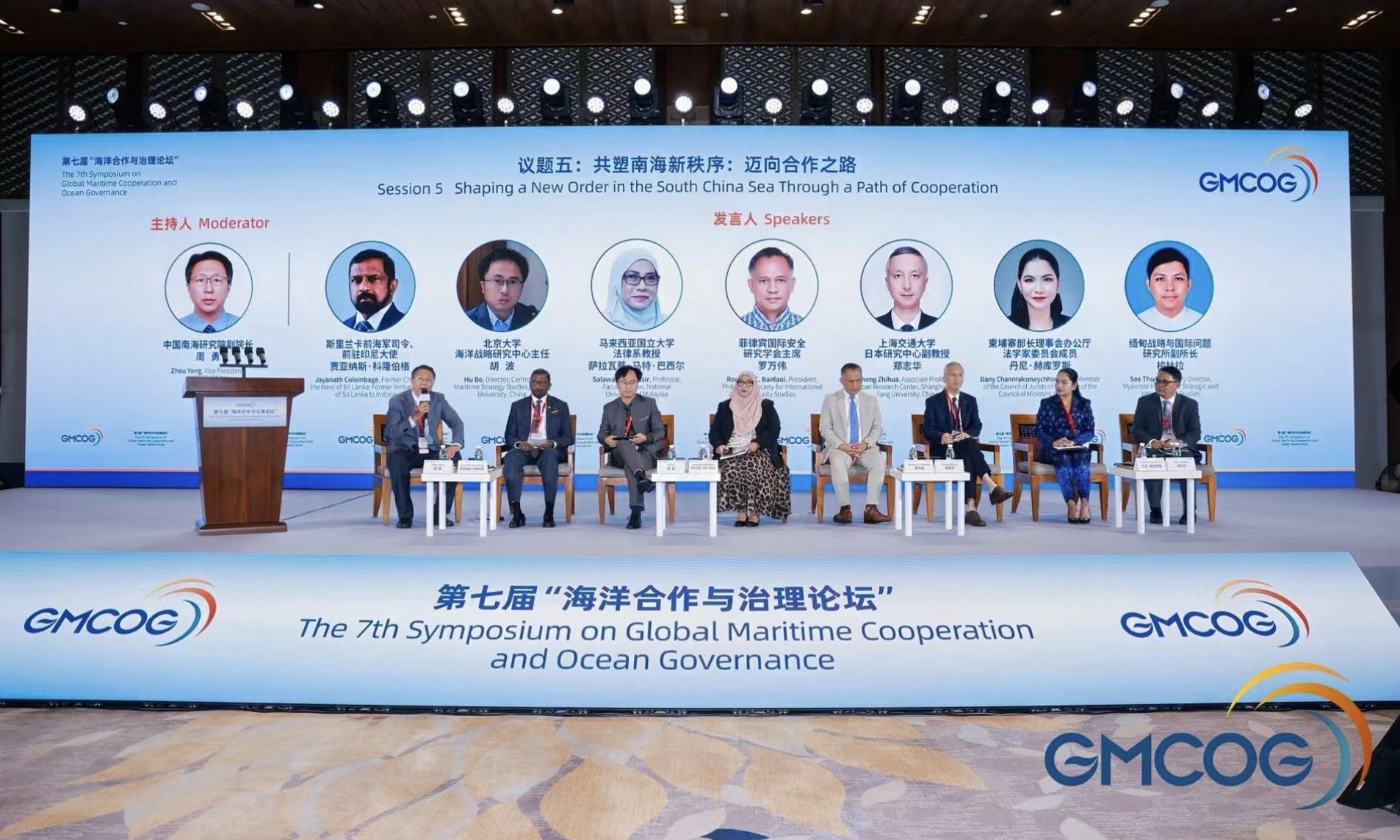
The Unwritten Foundations of Order in the South China Sea
Hu Bo
Order encompasses both the tangible and the intangible. Yet, international order relies far less on written rules than on invisible norms and shared consensus. All too often, we obsess over formal rules while blinding ourselves to these unwritten norms or frequently reiterated statements. This bias is glaringly obvious in discussions about the South China Sea order. We eagerly call for new institutions, mechanisms, and legal frameworks, hoping to build a binding regional order—completely missing the fact that beyond explicit international institutions and rules including UNCLOS, the region operates on deep-seated, unwritten norms and consensus.
First, shelving disputes. specifically, refraining from occupying new uninhabited features in the Spratly Islands, is the very foundation of peace and stability in the South China Sea, which is precisely what is embodied in the Declaration on the Conduct of Parties in the South China Sea (DOC). So far, with the exception of the Philippines, all other parties have adhered to this faithfully since the signature of DOC in 2002.
Second, self-restraint. Despite maritime and maritime frictions, all parties concerned have maintained a considerable degree of restraint, particularly in avoiding the use of force. Among them, China’s self-restraint deserves the highest praise. China’s power is vastly superior to that of the other parties, and its capabilities far exceed what they were thirty years ago. Yet, Beijing has consistently adhered to shelving disputes and managing differences through negotiation and dialogue—never once using lethal weapons against other parties, and has not fired a single shot towards other parties since the 1990s. In this regard, China is the most restrained party. Many criticize China for using watercannons. China is also a sovereign state; when its claimed rights and interests are challenged, it must respond. Watercannons are certainly not a good way to respond, but it is already a highly restrained action.
Third, the ASEAN Way. The ASEAN way emphasizes informality, gradualism, non-confrontational, and consensus-driven interactions among related parties. For instance, COC consultation. Many complain that the progress of COC consultation has taken too long and is slowly. However, this is essence of ASEAN way. They may not know that COC consultation is not between China and ASEAN, but among China and 10 or 11 ASEAN member states. Which means every article should be agreed by 11 or 12 partes and is bound to be process. Moreover, no matter what kind of context in the final document, the consultation itself is valuable, even more valuable than the final document.
Of course, we really should do more. The order in the South China Sea should indeed be better. In order to move further, we must be more pragmatic. No party will ever surrender its own sovereignty or maritime claims, nor can any party force another to abandon theirs. While each party steadfastly maintains its own position, it is in the interest of every party—and the interest of the entire South China Sea—to vigorously advance practical cooperation.
What Sustains Order in the South China Sea?
From Great-Power Restraint to Sustainable Regional Risk Governance
Zheng Zhihua
Regional order is generally sustained by three factors: restraint, consensus, and a balance of power. Rules and mechanisms are only part of consensus.
There is no doubt that all three matter. But none can sustain order on its own. Restraint sets a baseline; consensus provides reasons to act together; and a balance of power limits unilateral pressure. Rules, crisis management, and practical cooperation turn these conditions into everyday conduct. If any one is missing, the others become fragile. When restraint is the only stabilizing factor, peace depends on the parties’ immediate judgments rather than reliable common arrangements.
Order here means more than the absence of war. It means that conduct at sea is broadly predictable, that there are channels for handling incidents, that disagreements need not be expressed through dangerous encounters, and that cooperation remains possible beyond the disputes. The absence of armed conflict matters. But if every encounter can trigger a diplomatic crisis, calm at sea means only that nothing has gone wrong for the moment; it is not sustainable stability.
The complexity of the South China Sea’s has deep historical roots. It has long been a crossroads of navigation, trade, and fishing. Postwar sovereignty claims, maritime rights, and state practice have since been layered onto this history. The 1982 United Nations Convention on the Law of the Sea provides a common legal framework for maritime rights and obligations, but it has not resolved every question of territorial sovereignty, historical narrative, or maritime delimitation. Today’s tensions reflect the interaction of historical memory, legal interpretation, and material power. Reducing them to a choice between law and lawlessness, or between compliance and noncompliance, explains neither the disagreements nor how to manage them.
At least three gaps are now reinforcing one another.
First is a gap in perceptions of facts, rules, and legitimacy. One party may describe a maritime action as law enforcement or the protection of rights; another may call it coercion or provocation. In September 2026, for example, the Philippine Coast Guard said that Chinese vessels had obstructed a resupply mission. After incidents of this kind, differing judgments about facts, rules, and legitimacy quickly become entangled in competing media and diplomatic narratives.
Public-opinion, information, and legal warfare widen this gap further. Unverified accounts can become conclusions before the facts are established; legal language can shift from interpreting rules to mobilizing support. Consensus then not only fails to grow: even minimal agreement about what happened begins to erode. Reversing this requires separating three things: what facts can be verified, what legal claims each party makes, and how each party assesses those claims. This distinction does not mean neutrality about the law, nor does it imply equal responsibility. It gives debate a chance to rest on common facts.
Second is a gap between the authority of rules and their interpretation. The 2016 South China Sea arbitral award made an important interpretation of Article 121(3) of the Convention. It found that Taiping Island could not sustain human habitation or an economic life of its own and therefore could not generate an exclusive economic zone or continental shelf. The long-standing criticism that this interpretation departs from the practice of most states has led some states and scholars to take a closer look at the award’s interpretive method, its treatment of state practice, and the universality of the rule. Selective invocation of rules spreads double standards. It also strengthens the tendency of sovereign states to weaponize and deliberately exploit rules, further damaging the credibility of rules and international institutions.
Third is a gap between the distribution of power and security expectations. Geographic proximity, the ability to maintain a sustained presence, and the size of coast guard and maritime forces all affect the practical ability of parties to uphold their claims. The United States continues to project power and remain involved in the South China Sea, but the shift in its strategic focus and the reduction in the resources it commits overall are undeniable. Questions also remain about its priorities and the predictability of its future commitments. Outside powers such as Japan and Australia cannot fill this gap. Their role is limited; they are more symbolic than substantive substitutes. Meanwhile, the balance of power in the South China Sea is not static. China’s regional advantage continues to grow and is becoming overwhelming in some respects.
Changes in the balance of power can create anxiety and even panic. They must therefore be accompanied by communication, transparency, and clear crisis procedures; otherwise, one party’s defensive measures may still appear to another as preparations for offense.
These three gaps show that the problem is not a lack of principles, but a lack of connection among them. Can restraint endure? Must consensus wait until all parties reach the same view of history and law? Can efforts to maintain a balance of power avoid becoming an arms race? These are the questions we must address directly.
First, restraint is indispensable, but it cannot be the sole pillar. It can keep an encounter from becoming a conflict, but it cannot be sustained reliably if it depends only on leaders’ momentary decisions or is seen by one party as a unilateral concession. Effective restraint must be reciprocal, observable, and translated into rules of conduct: how to communicate during a dangerous encounter, what to do after an accident, which actions require advance notice, and how to prevent casualties and sudden escalation.
Second, consensus should not mean that all states must adopt the same position on sovereignty, history, and the arbitral award. Such comprehensive consensus is unrealistic in the near term and is not a prerequisite for crisis management. A more practical goal is procedural and behavioral consensus: what information should be exchanged promptly, who answers the hotline, how an incident at sea is verified, and how disputes are referred to diplomatic channels. Differences can remain, but they should not become a reason to refuse communication.
Third, a balance of power is necessary, but it should serve to deter coercion, not to overwhelm the other side. Regional states need to develop maritime-domain awareness, professional coast guard capabilities, and crisis-response capacity. External partners can provide support, but that cooperation should be transparent and predictable, and should respond to security needs defined jointly by regional states. ASEAN centrality cannot be merely a forum for meetings; it must be reflected in members’ ability to coordinate positions, set an agenda, and carry out common decisions.
On this basis, I propose four practical steps.
First, make the Code of Conduct in the South China Sea a workable text. In 2026, ASEAN and China publicly set the goal of concluding negotiations by year’s end; but the signing date is not the only measure of success. The Code should prioritize concrete risks: dangerous encounters at sea, emergency communications, incident reporting, transparency around exercises, and procedures for de-escalating disputes. It need not replace sovereignty negotiations, nor can it supersede the Convention or existing legal positions. Rather than pursue a comprehensive but unenforceable long text, the parties should first establish concise, workable rules that reduce risk. The Code should answer a practical question: when the next dangerous encounter occurs, what exactly should the parties do?
Second, establish a common process for handling incidents. Coast guards and relevant agencies should have regular channels of contact and emergency communication procedures. After a major incident, they should promptly exchange basic information, including the time and location, vessels involved, radio communications, on-scene images, and the safety of personnel. Verify the facts first; then state legal positions and assessments of responsibility separately. This will not eliminate disagreement, but it can reduce rumors, miscalculation, and public judgments made before the facts are known.
Third, turn ASEAN centrality into regional capacity for independent action. Training, equipment, and intelligence cooperation from external partners should be as transparent and predictable as possible, serve risk-management goals jointly defined by regional states, and not fuel geopolitical confrontation. ASEAN members can strengthen coordination among themselves before working with external partners. ASEAN centrality must mean more than a meeting table: it must be reflected in members’ ability to coordinate, set an agenda, and follow through on commitments. Regional states need not choose sides, but they must avoid losing their capacity for independent judgment and space for communication during a crisis.
Fourth, restore habits of cooperation in areas where common interests remain. Search and rescue, fisheries management, marine environmental monitoring, pollution response, and disaster relief may not resolve sovereignty disputes, but they can keep relevant agencies in contact and ensure that relations at sea do not revolve solely around confrontation. Cooperation is not a way to conceal disagreements; it is a way to prevent them from crowding out other forms of cooperation.
So, what sustains order in the South China Sea? Restraint, but not restraint alone; consensus, without waiting for comprehensive agreement; and a balance of power, without allowing it to become unending confrontation. Rules, communication, and practical cooperation are also needed to make restraint repeatable and turn fragile consensus into procedures that can be carried out.
Regional states need not first agree on a single account of the past in order to manage the future together. They can begin by agreeing on how to avoid collisions, verify incidents, and maintain communication. Great-power restraint remains important, but peace cannot depend on the great powers making a restrained choice every time. A truly sustainable order is one in which disagreements persist without automatically turning into crises.
Hu Bo

Hu Bo, Research Professor and Director of the Center for Maritime Strategy Studies, Peking University, and Director of SCSPI. His areas of specialization include maritime strategy, international security, and Chinese diplomacy. He has written three books and more than 40 journal articles and book chapters on topics related to China’s maritime strategy and policy. His most recent books published in Chinese are as follows: China’s Maritime Power in 2049 (Beijing, China Development Press, 2015); China’s Sea Power in the Post Mahan Era (Beijing, Ocean Press, 2018); and forthcoming: Chinese Maritime Power in the 21st Century (Routledge, 2019).
Zheng Zhihua

Dr. ZHENG Zhihua is an associate Professor of Japan Research Center of Shanghai Jiaotong University, and Head of East Asia Marine Policy Project. He is currently a visiting scholar at the Huayang Centre for Maritime Cooperation and Ocean Governance in Haikou. He is also a member of the Professional Committee of Maritime History and Culture Research of the China Maritime Society. He severed as the director of Joint Institute for Maritime Law and History, assistant dean of the School of International Shipping Law at East China University of Political Science and Law (ECUPL), and deputy secretary general of Shanghai Law and Society Association. He joined the board of editorial of China Ocean Law Review and severed as senior editor from 2010 to 2013. He was appointed as Judge of Ningbo Maritime Court in 2004. He got qualification for admission to the Chinese Bar in 1998. He was a visiting fellow of St. John’s College at Oxford University, Institute of Maritime Law at Southampton University and Law Faculty at Göettingen University.