
February 1, 2026 marks the fifth anniversary of the official implementation of the Coast Guard Law of the People’s Republic of China. On January 30, Zhang Jianming, the Director of the China Coast Guard, briefed the public on the progress of maritime rights protection and law enforcement since the law’s enactment. Zhang emphasized that the China Coast Guard (CCG) “resolutely follows the decisions of the Party Central Committee, and adheres to a strategy of situation-specific responses, preventing and regulating foreign infringements and provocations in accordance with the law”. He added that the force has “firmly defended China's territorial sovereignty and maritime rights”. According to Zhang, over the past five years, the CCG has deployed 550,000 vessel sorties and 6,000 aircraft sorties in support of these missions.[1]
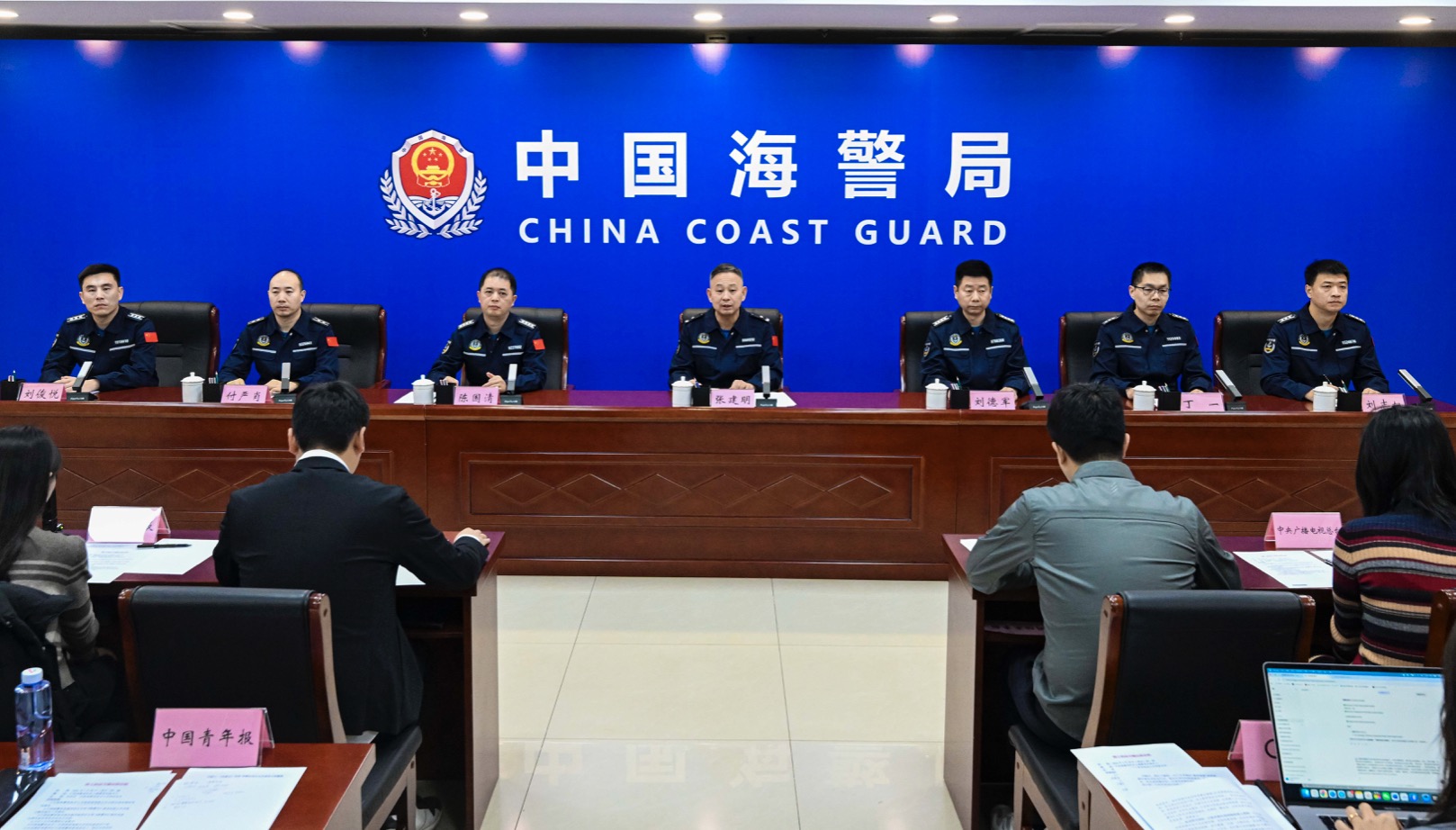
Source: China Coast Guard
Coincidentally, on January 29, 2026, the Washington-based US think tank Center for Strategic and International Studies (CSIS)’s Asia Maritime Transparency Initiative (AMTI) published an anonymous analysis titled “Eyes on the Prize: CCG Patrols Prioritize Scarborough in 2025”,[2] arguing that CCG operations in the South China Sea underwent a “major shift” in 2025, with intensified patrols around Scarborough Shoal (Huangyan Dao) and Sabina Shoal (Xianbin Jiao). This piece can be regarded as a follow-up to their June 2025 report[3] on a similar theme. While AMTI’s use of AIS data and graphic analysis offers a quantitative snapshot of patrol patterns, its interpretation reflects a familiar US-style analytical lens that emphasizes “resource reallocation” and “flashpoints” while insufficiently accounting for China’s legal position, security concerns, and long-standing sovereignty claims. From an unbiased perspective, this commentary argues that the observed patrol patterns of the CCG in 2025 were neither abrupt nor destabilizing, but rather a rational and restrained exercise of maritime law enforcement, fully consistent with China’s sovereign rights and responsibilities in these waters.
Reasonable Presence to Uphold Sovereignty and Maritime Jurisdiction
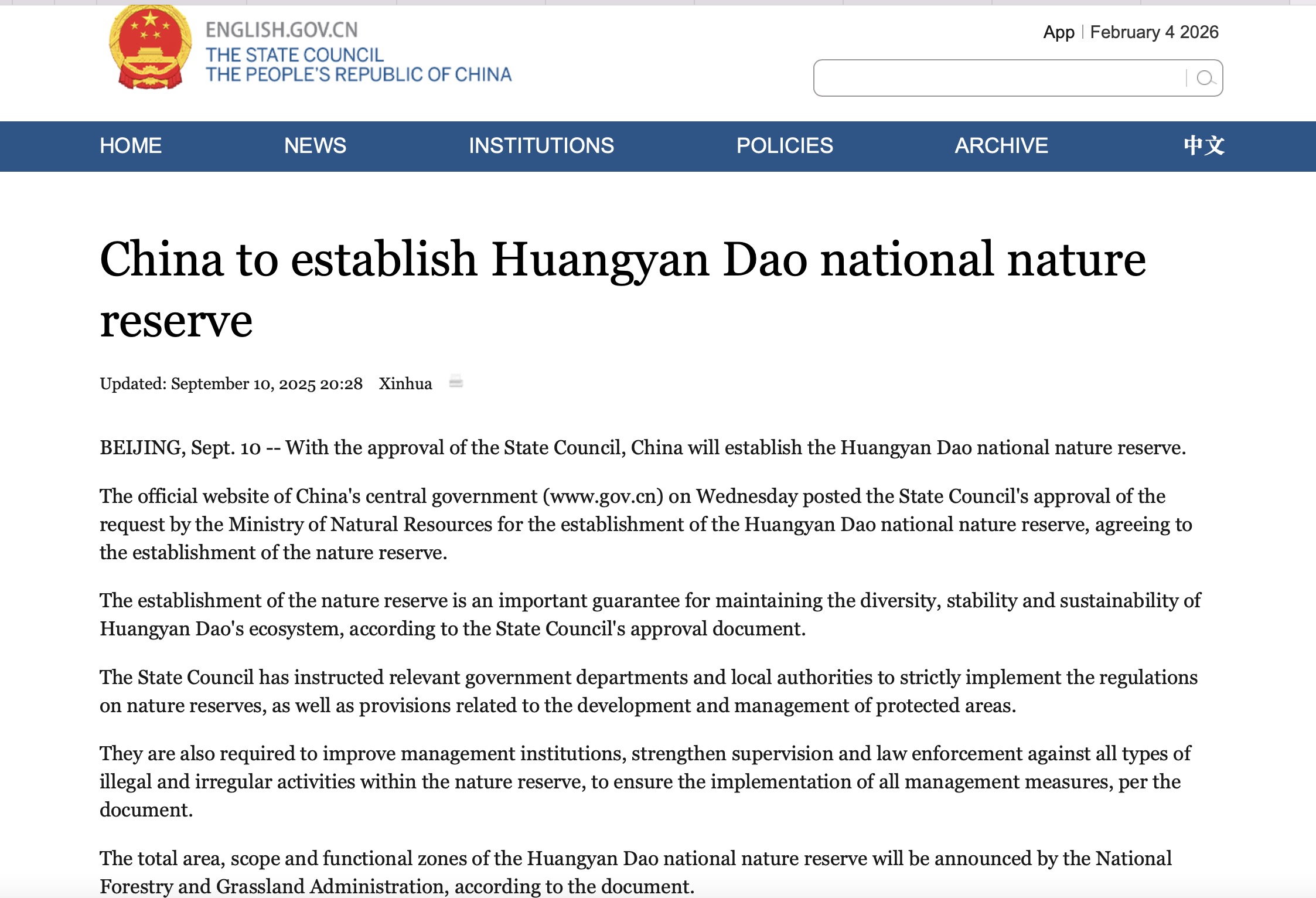
First and foremost, any meaningful assessment of CCG operations must take account of China’s consistent and well-documented position that it possesses indisputable sovereignty over the Nanhai Zhudao (South China Sea Islands, specifically its four major archipelagos), and their adjacent waters, which is firmly grounded in historical, legal, and administrative facts.[4] According to China’s official position, Scarborough Shoal (Huangyan Dao) is its inherent territory, over which it has exercised sovereignty and jurisdiction continuously, peacefully and effectively.[5] In November 2024, China published its baselines around Huangyan Dao. [6] In September 2025, China established the Huangyan Dao National Nature Reserve. [7] Consequently, the reinforcement of CCG presence in 2025 should be interpreted as a legitimate act of maritime law enforcement within waters under China’s jurisdiction, rather than a “shift” intended to change the status quo.
In addition, AMTI’s framing rests on the flawed premise that Scarborough Shoal and Sabina Shoal are merely disputed areas, overlooking the reality that Chinese patrols are defensive responses to escalating frequent infringements and provocations by external actors. In recent years, Philippine government vessels, often accompanied by media crews and backed by extra-regional powers, have repeatedly intruded into China’s jurisdictional waters. These actions intentionally raised tensions under the guise of “resupply” [8] or “traditional fishing rights”. [9] Against this background, a sustained CCG presence is not only reasonable but indispensable to uphold maritime order and prevent miscalculation in these critical waters.
Justified Maritime Enforcement Shows Restraint, Not Escalation
A key shortcoming of the AMTI analysis lies in its implicit tendency to equate increased CCG patrol frequency with coercion, even though terms like “coercion” or “militarization” are not explicitly invoked. In fact, the CCG is inherently a maritime law-enforcement agency, not a quasi-naval force by nature (though it can be transformed into naval forces), [10] and its operations such as identification, monitoring, warnings, and escorting, are standard practices employed by coast guards worldwide. Therefore, the surge in ship days at Scarborough Shoal in 2025, framed by AMTI as “unprecedented”, should be interpreted more accurately as a measure of enhanced administrative control rather than militarization.
Indeed, China’s reliance on coast guard vessels to conduct routine operations, rather than naval assets, serves as a testament to its self-restraint tenet. Had China’s intent been escalation, the People’s Liberation Army Navy (PLAN) would undoubtedly be the primary instrument of choice. Instead, China has consistently prioritized managing disputes through maritime law enforcement mechanisms, dialogue (the latest one was held on January 29, 2026, the very day AMTI published its analysis), [11] and crisis management, which is fully aligned with the 2002 Declaration on the Conduct of Parties in the South China Sea (DOC).
Responding to External Pressures and Regional Changes
AMTI attributes the concentration of patrols in 2025 to a “reallocation of resources”, implying a calculated strategy to pressure the Philippines. However, this interpretation neglects the broader strategic context. The South China Sea has seen growing involvement by external powers, particularly the United States, which has intensified military deployments, joint patrols, and intelligence sharing with regional allies. Notably, the latest Philippine-US joint patrol remains ongoing as of the week of January 26, 2026.[12] Such operations have exacerbated security risks and emboldened certain claimant states to adopt more confrontational postures. Furthermore, throughout 2025, India,[13] Canada, Australia,[14] Japan and France [15] also held several large-scale joint air-naval exercises with the Philippines in these disputed waters.
From this perspective, the CCG’s focus on Scarborough and Sabina Shoal reflects a defensive adjustment to on-the-ground realities. Maintaining a regular presence helps deter unilateral actions that could undermine stability, exemplified by the Manila’s frequent attempts to internationalize bilateral disputes. Accordingly, far from destabilizing the region, the CCG patrols contribute to predictability by clearly demarcating China’s red lines while avoiding the use of force.
Methodological Limits of AIS-Based Analysis
While AMTI acknowledges that AIS data provides merely a “minimum estimate” of CCG activity, its analysis nonetheless relies heavily on quantitative variations in ship days. This methodology risks overinterpretation. Fluctuations in patrol frequency may result from technical, seasonal, or operational factors, including weather, vessel rotation, or coordination with other maritime agencies. Moreover, AIS data cannot capture the intent, rules of engagement, or outcomes of patrols, all of which are essential to judging whether the observed behavior constitutes escalation or stabilization.
By focusing narrowly and exclusively on numerical increases or decreases at specific features, the analysis obscures the continuity in China’s overall approach: safeguarding sovereignty and jurisdiction while avoiding open confrontation. The relative decline in patrols at certain locations, such as Second Thomas Shoal (Ren’ai Jiao) or Thitu Island (Zhongye Dao) in some months, coupled with increases in other periods-notably when the Philippines attempted to land personnel on Sandy Cay (situated only 1.5 nautical miles northwest of Thitu Island) could equally be interpreted as evidence of tactical flexibility and strategic prioritization, rather than indiscriminate expansionism.
Conclusion
A genuinely constructive analysis of South China Sea dynamics should move beyond zero-sum interpretations of Chinese actions. China has consistently articulated [16] its commitment to managing disputes through negotiation, advancing consultations on the South China Sea Code of Conduct (COC), and upholding peace and stability. CCG patrols should therefore be regarded as one component of this broader strategy, serving as a stabilizing mechanism that preserves maritime order while leaving space for diplomacy.
In essence, the evolution of CCG patrol patterns in 2025 represents continuity rather than rupture: a justified, restrained, and necessary effort to protect sovereignty and maritime rights within an increasingly complex and challenging security environment. Far from signaling aggression, CCG operations underscore China’s preference for law enforcement and crisis management over militarization. US think tanks’ analyses should incorporate this perspective if they are to contribute meaningfully to regional understanding and stability, rather than perpetuate stereotypical suspicion and misinterpretation.
Reference
[1] See “The China Coast Guard Held a Special Interview on Maritime Law Enforcement”, China Coast Guard, January 30, 2026, https://www.ccg.gov.cn/xwfbh/202601/t20260130_2985.html, accessed January 30, 2026.
[2] Asia Maritime Transparency Initiative, “Eyes on the Prize: CCG Patrols Prioritize Scarborough in 2025”, January 29, 2026, https://amti.csis.org/eyes-on-the-prize-ccg-patrols-prioritize-scarborou..., accessed January 30, 2026.
[3] Asia Maritime Transparency Initiative, “Holding the Line: China’s Expanding Patrols around Scarborough Shoal”, June 16, 2025, https://amti.csis.org/holding-the-line-chinas-expanding-patrols-around-s..., accessed January 30, 2026.
[4] See “Statement of the Government of the People's Republic of China on China's Territorial Sovereignty and Maritime Rights and Interests in the South China Sea”, Ministry of Foreign Affairs of the People’s Republic of China, July 12, 2016, https://www.fmprc.gov.cn/nanhai/eng/snhwtlcwj_1/201607/t20160712_8527297..., accessed January 30, 2026.
[5] See “China Adheres to the Position of Settling Through Negotiation the Relevant Disputes Between China and the Philippines in the South China Sea”, Ministry of Foreign Affairs of the People’s Republic of China, July 13, 2016, https://www.fmprc.gov.cn/nanhai/eng/snhwtlcwj_1/201607/t20160713_8527301... January 30, 2026.
[6] See “Statement of the Government of the People's Republic of China on the Baseline of the Territorial Sea Adjacent to Huangyan Dao”, https://www.un.org/depts/los/LEGISLATIONANDTREATIES/PDFFILES/DEPOSIT/Chn... January 30, 2026.
[7] See “China to Establish Huangyan Dao National Nature Reserve”, September 10, 2025, https://english.www.gov.cn/policies/latestreleases/202509/10/content_WS6... January 30, 2026.
[8] See “Philippine Coast Guard Resupplies Fishermen in the South China Sea Despite Chinese Harassment”, USNI News, October 8, 2025, https://news.usni.org/2025/10/08/philippine-coast-guard-resupplies-fishe... January 30, 2026.
[9] See Ding Duo, “Time to End the Philippine Fishing Supply Farce”, China Daily, October 10, 2025, https://www.chinadaily.com.cn/a/202510/10/WS68e877eca310f735438b434a.html, accessed January 30, 2026.
[10] See Article 83 of the Coast Guard Law of the People’s Republic of China.
[11] See “China and the Philippines Hold a Bilateral Dialogue on Maritime Affairs and Other Issues”, Ministry of Foreign Affairs of the People’s Republic of China, January 29, 2026, https://www.fmprc.gov.cn/eng/xw/wjbxw/202601/t20260129_11847580.html, a... January 30, 2026.
[12] See “Philippines, US Hold Joint Military Drill at Disputed South China Sea Shoal”, Reuters, January 27, 2026, https://www.reuters.com/world/china/philippines-us-hold-joint-sail-dispu..., accessed January 30, 2026.
[13] See “Philippines, India Hold First Joint Naval Drill in Disputed South China Sea”, Al Jazeera, August 4, 2025, https://www.aljazeera.com/news/2025/8/4/philippines-india-hold-first-joi..., accessed January 30, 2026.
[14] See “Australia, Canada, the Philippines and the United States Conduct Maritime Cooperative Activity”, Australian Government, September 4, 2025, https://www.defence.gov.au/news-events/releases/2025-09-04/australia-can... 30, 2026.
[15] See “Philippine, Allied Warships Hold Combat Drills in the South China Sea”, USNI News, October 16, 2025, https://news.usni.org/2025/10/16/philippine-allied-warships-hold-combat-... 30, 2026.
[16] See “Foreign Ministry Spokesperson Guo Jiakun’s Regular Press Conference on October 22, 2025”, Ministry of Foreign Affairs of the People’s Republic of China, October 22, 2025, https://www.fmprc.gov.cn/nanhai/eng/fyrbt_1/202510/t20251022_11738636.ht... 30, 2026.
Bao Yinan

Dr Yinan BAO is currently an Associate Research Fellow at Huayang Center for Maritime Cooperation and Ocean Governance. He specializes in public international law, with a focus on diplomatic law and the law of the sea. He has published over twenty academic papers on public international law, covering topics such as diplomatic law and the law of the sea. He has also authored Chinese and English commentary articles for platforms including Global Times, The Paper, Guancha.cn, The Diplomat, Voice of the South China Sea, etc.